
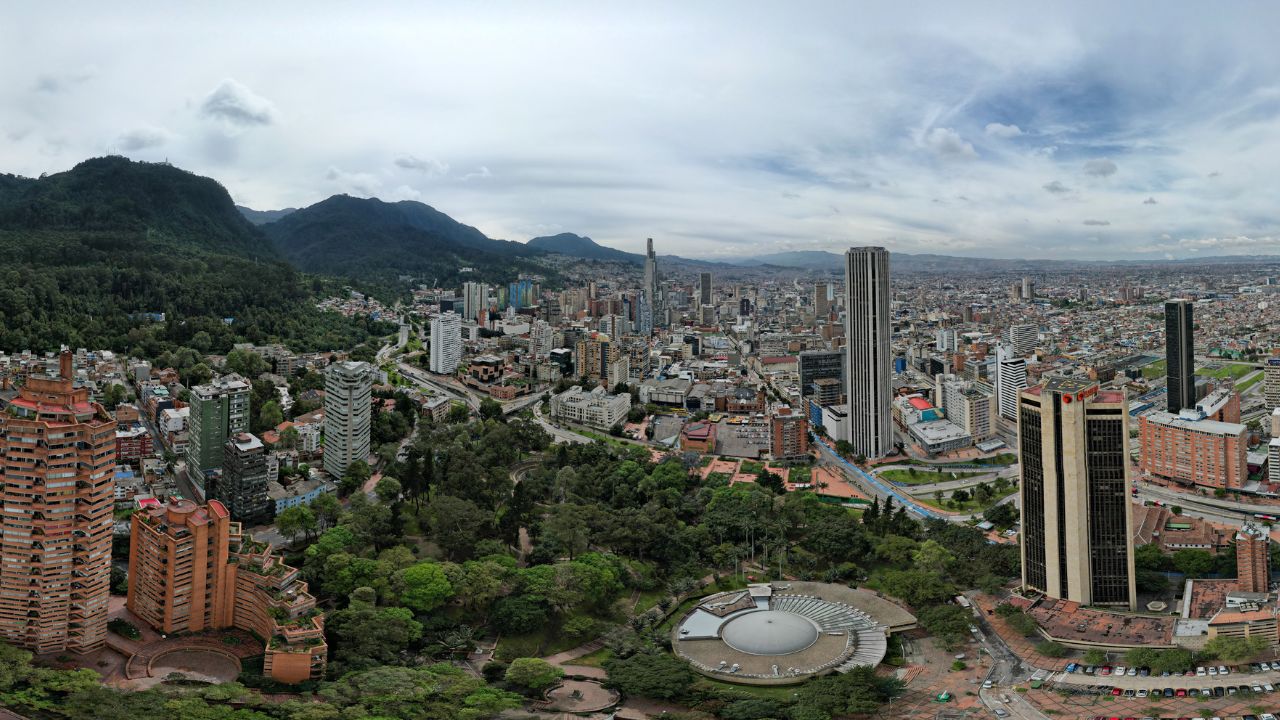
Bogotá is the capital and most populous city of Colombia. As a convergence point for people from all over the country, it is diverse and multicultural, blending the old with the new. With over seven million inhabitants, it is one of the largest cities in South America.
Located in the heart of Colombia, on the Cundiboyacense plateau and the savanna that bears its name, it is part of the Andean region, one of the country’s six regions. It is verdant, and 75% of its territory is rural. The climate is largely due to its strategic location: at 2,600 meters above sea level and surrounded by mountains, it enjoys a temperate climate with an average daytime temperature of 19°C.
As a visitor, one can appreciate its architecture, a mix of styles ranging from modern buildings to the facades of old houses that are authentic colonial treasures. Thanks to this fusion between past and present, it is a destination with history that unites the best of Colombia with fun, gastronomy, culture, business and more.
For this reason, in 2021 Bogotá received two awards at the World Travel Awards: South America’s Leading Business Travel Destination and South America’s Leading City Destination. This positioned it as a leading business destination and an international benchmark for tourism.
Regarding the performance of the tourism sector, Bogotá received 10,558,274 domestic tourists and 1,904,457 international tourists in 2019, and 3,567,534 and 601,322 respectively in 2020, for a total of 4,168,856 tourists.
Tourist spending in 2019 was US$2.464 billion, of which US$1.523 billion came from domestic tourists and US$941 million from international tourists. In 2020, this figure was US$785 million, of which US$505 million came from domestic tourists and US$280 million from international tourists.
| Joining the Smart Destinations project | Bogotá joined the Smart Tourism Destinations project in 2021, at which time the Diagnostic Report and Action Plan for its transformation into a Smart Tourism Destination were developed. In 2023, it underwent its first Smart Tourism Destination review and achieved the Smart Tourism Destination distinction, exceeding 80% of the requirements of the Smart Tourism Destination methodology. It will renew this distinction in 2026. |
| Outstanding initiatives
|
– Creation of the Accessible Tourism Network: This network aims to consolidate the accessible offerings of service providers and tourist attractions in the city. Its activities are guided by the following principles:
• Develop ongoing training and technical assistance in accessibility and accessible tourism. • Provide self-assessment tools for implementation in facilities. • Promote productive linkages. • Promote accessible tourism products in Bogotá and the surrounding region. • Increase competitiveness opportunities based on specific needs and differentiating factors. – The District Tourism Fund (FONDETUR) has the mission of promoting sustainable human and tourism development in Bogotá and the surrounding region through the execution, management, and administration of tourism projects and related sectors. FONDETUR’s objective is to finance, co-finance, and advise on the development of private initiatives from community groups, entrepreneurs, business owners, and other groups linked to the tourism sector that foster job creation, equal opportunities, and human development in the tourism-related areas. – District Tourism Advisory Council: created in 2021 as a coordinating body for tourism in Bogotá, its objective is to serve as an advisory body to the district administration regarding the development of the tourism industry; it is made up of tourism sector associations, business owners, the tourism police, El Dorado Airport, the Transportation Terminal, the Secretariat of Economic Development, the District Tourism Institute and guests who join according to the topics covered in the council sessions. – District Tourism Public Policy: In 2021, the Public Agenda phase was developed within the framework of formulating the District Tourism Policy. This involved 36 events with the participation of 741 people, taking a sectoral, population, and territorial perspective. These events allowed for the identification of the individual and collective perceptions of stakeholders in the tourism system. This information was then used to collaborate with these stakeholders on the main programmatic elements of the public tourism policy through co-creation and dialogue. This Public Policy serves as the roadmap for the city’s tourism development in the medium and long term. – District System of Tourism Quality – SIDCAT: is a system that is part of Smart Tourist Destination, which articulates the management of the IDT to form a set of tools that allow improving the quality levels of tourism services, through the implementation and distinction of good practices in business management in aspects such as governance, security, innovation, technology, sustainability and inclusion, considering the size and technical, financial and operational capacities of the entrepreneurs, promoting continuous improvement towards smart management and their preparation to address certification processes on standards that improve their positioning in the market. – Bogotá Tourism Observatory: responsible for developing studies and research related to the city’s tourism activity, providing data for decision-making by stakeholders in the tourism sector https://www.idt.gov.co/es/sitbog – Bogotá Smart Territory Policy: The High Council for ICT has been working on the Bogotá Smart Territory Policy, which aims to improve citizens’ quality of life through the efficient and strategic use of technology, data, and innovation. This policy seeks to establish the strategic lines on which the district will focus regarding technology, data, and innovation by 2030. – Spatial Data Infrastructure (IDECA): Its objective is to facilitate the discovery, access, interoperability, and reuse of geographic information through collaborative and coordinated work, contributing to decision-making that benefits the city and its inhabitants. IDECA has been built upon five (5) components that, together, strengthen the management and handling of geographic information within the entities of the Capital District: community, policies and standards, data, technology, and institutional strengthening. – Circular Economy: Since the beginning of 2021, the District Tourism Institute has been planning how the tourism sector could actively participate in circular economy pilot projects. These projects emphasize a systemic model for resource utilization focused on reducing, reusing, and recycling materials, prioritizing environmental protection and sustainable economic development. Under this model, a pilot project was launched in collaboration with the Glass Museum and other participating companies to develop a tourism-focused work plan that highlights the environmentally sound management of waste within a circular economy framework. |
