
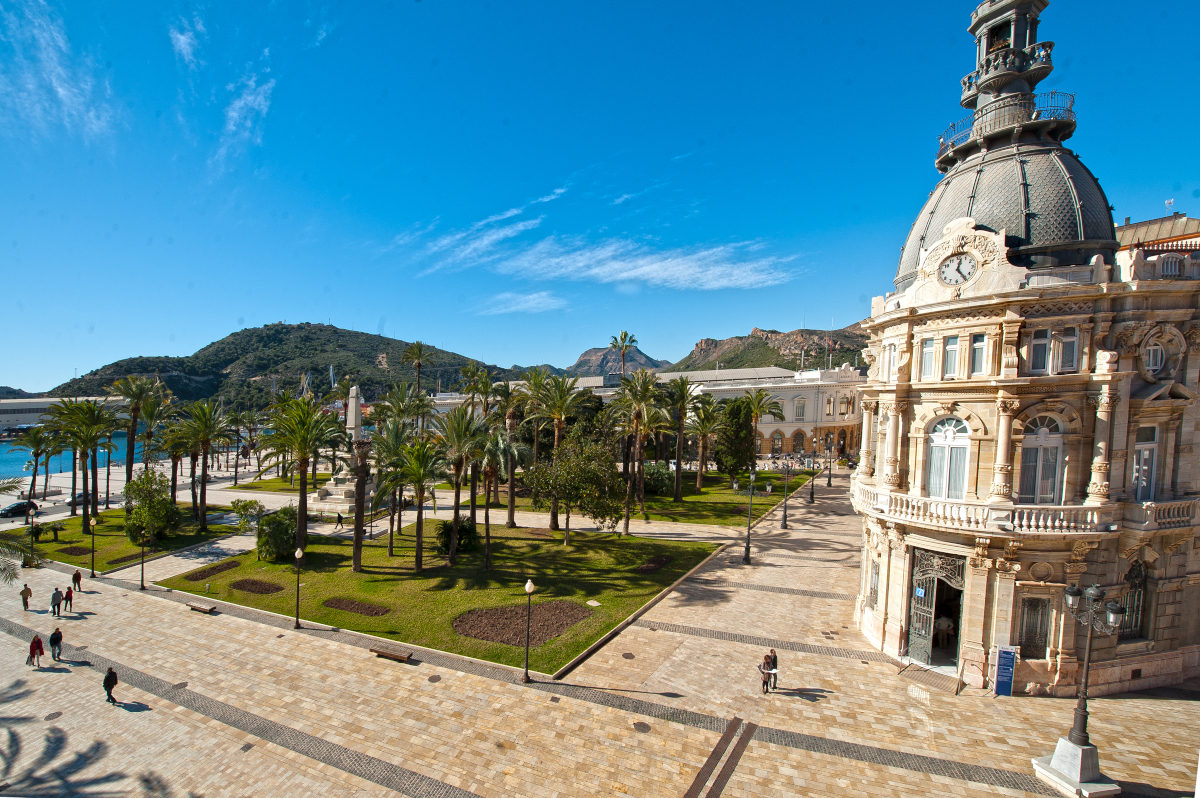
The city of Cartagena is a port city open to the Mediterranean Sea through a wide bay. The natural harbor of Cartagena currently has two docks, and its entrance is guarded by a series of castles and coastal batteries built in the 18th and 19th centuries.
The city is the seat of the Regional Assembly, the legislative body of the Autonomous Community.
In natural surroundings, its two protected areas can be visited: to the west, Cabo Tiñoso, and to the east, the Calblanque Regional Park.
The beauty and conservation of Cartagena’s seabeds have made it one of the preferred destinations for scuba diving in Spain. Notable sites include the marine reserves of Cabo de Palos and Islas Hormigas, as well as the marine reserve of fishing interest at Cabo Tiñoso (to the west of the city), highlighting extensive seagrass meadows and coral colonies. In addition, remains from other periods can be found, from Roman shipwrecks to vessels sunk during the Spanish Civil War.
Among its most notable festivals are Holy Week, declared of International Tourist Interest in 2005, and Carthaginians and Romans, declared of International Tourist Interest in 2017.
One of the most distinctive products of Cartagena’s gastronomy is salt-cured fish. The main fish dish of the city and its surrounding countryside is undoubtedly the caldero, combining rice with fish from the Mediterranean and the Mar Menor. Seafood is complemented by a wide variety of products from the Campo de Cartagena. And, of course, there is the coffee known as the asiático, a mixture of coffee with condensed milk, brandy, cinnamon, Licor 43, and a slice of lemon peel, all served in a unique glass designed exclusively for this purpose.
| Admission to the Smart Tourism Destinations Project | The Smart Tourism Destination diagnostic and action plan process for Cartagena began in 2024 and was completed in June 2024. |
| Key Initiatives
|
|
