
Comarca del Valle del Alagón — Where time flows like the river
There are places that are not visited, but felt. The Alagón Valley, in the northwest of the province of Cáceres, is one of them. A territory where water is the defining element of the region: its various rivers provide extraordinary environmental and scenic richness, and where every bend in the road reveals centuries of history intertwined with a nature that still breathes freely.
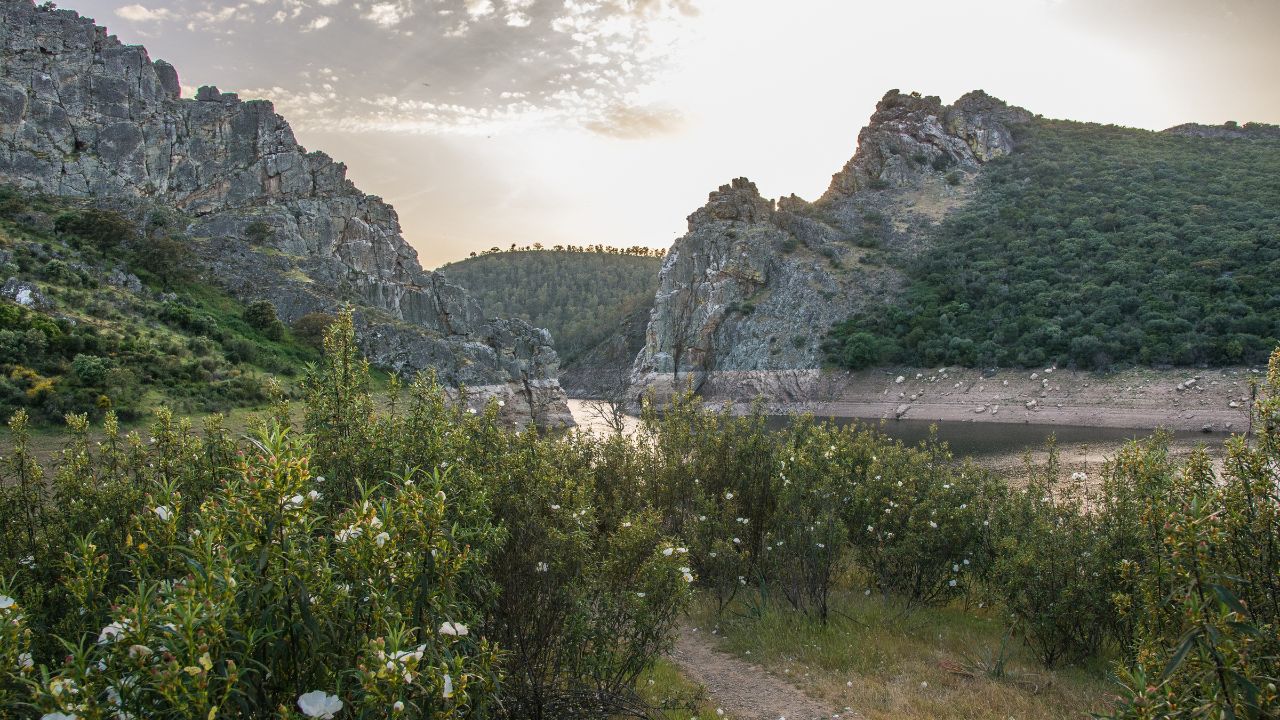
The Alagón River sculpts the imposing Canchos de Ramiro —an almost surreal landscape, where a wall of rock broken by the river forms a kind of gateway of vertical cliffs— one of the best places in the region to observe the griffon vulture and the black vulture. Golden eagles, Bonelli’s eagles, peregrine falcons, Egyptian vultures, black storks and Iberian imperial eagles soar over a territory that is a true paradise for birdwatching. And if autumn finds you here, the red deer rut in various parts of the region becomes one of its greatest attractions.
But the Alagón Valley is also stone and memory. Coria, an ancient city that once served as a stop along the Roman Vía de la Plata and as the seat of the powerful House of Alba during the Middle Ages, treasures within just a handful of streets the Cathedral of Santa María de la Asunción, the Palace of the Dukes of Alba, the Castle of the House of Alba, the Franciscan Monastery, and its medieval bridge which, curiously, lost its river centuries ago. Its Roman walls, built to protect the settlement from invasions, still stand as testimony to a history that endures.
A few kilometers away, Galisteo preserves its medieval walls made of rounded stones and a Mudéjar apse that speaks of the coexistence of cultures that shaped this land. In Portezuelo stands watch the Castle of Marmionda. In Zarza la Mayor, the Castle of Peñafiel dominates the canyons of the Erjas River. And over all of them, the complicit silence of the dehesa.
This region is also a land of artisans and festivals that ignite the soul. In Montehermoso, bronze bells are still cast and the famous traditional caps are made, a fundamental part of the best-known regional costume of Extremadura. In Ceclavín, potters create vessels with embedded small stones —the so-called “enchinado” ceramics— and goldsmiths keep centuries-old crafts alive. In Torrejoncillo, embroidery and traditional shoemaking continue to thrive. And when the night of December 7 arrives, the Encamisá of Torrejoncillo lights up the streets with its cloaked riders. In January, the Carantoñas of Acehúche (Festival of National Tourist Interest), and in February, the Negritos de San Blas of Montehermoso revive ancestral rituals that still send shivers today. And in June, the Bulls of San Juan in Coria awaken the entire region.
All of this can now be explored with sustainability as a guiding principle. The Alagón Valley region has taken a firm step toward the future as an affiliated Smart Tourist Destination, embracing technology, connectivity, and innovative management in service of a traveler who deserves the very best of this unique corner of Extremadura.
Come and discover the Alagón Valley. Here, time is not lost: it is found.
| Incorporation into the Smart Tourism Destinations Project | The Alagón Valley region obtained the Diagnostic Report and Action Plan for its transformation into a Smart Tourist Destination in January 2026 |
| Key initiatives
|
Spring in the Dehesa is the flagship program of activities in the Alagón Valley region. Promoted and organized by ADESVAL —Local Action Group of the Alagón Valley—, it was the project most valued by the inhabitants of the region in a public vote held on the occasion of ADESVAL’s 30th anniversary, and one of the longest-running initiatives in the area. It was created to promote the region based on its identity markers and is built year after year through participatory processes. It is an event that encompasses a wide range of activities —conferences, environmental workshops, cultural, sports, and gastronomic activities— held across the towns of the Alagón Valley. Its celebration takes advantage of the best time of year in the dehesa: spring, when the rockrose blooms and the landscape reaches its peak splendor. |
